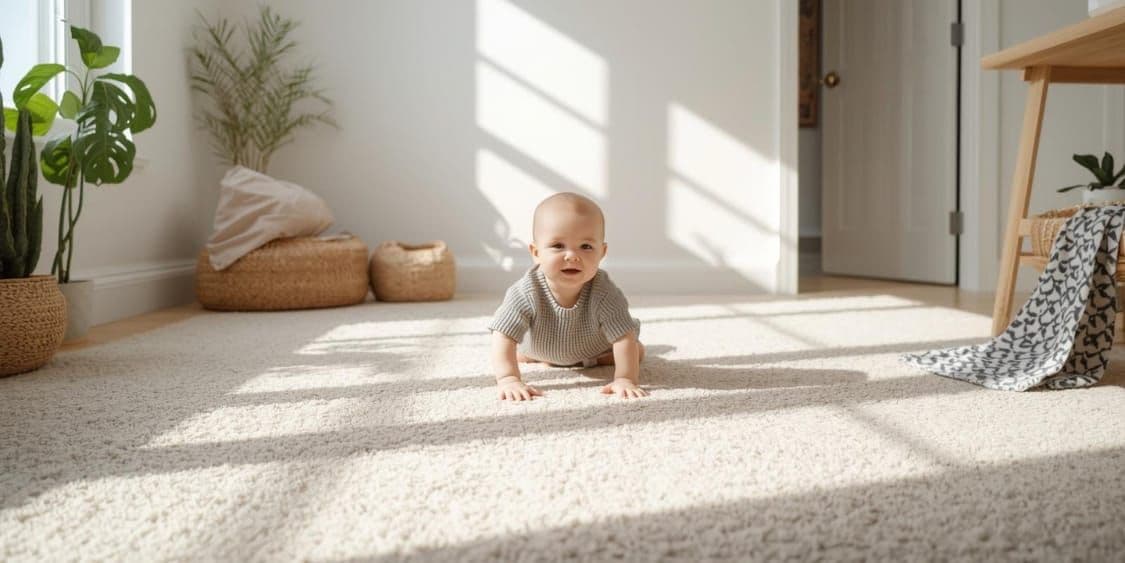
The part that never made sense is that it's worse inside. You'd expect allergies to hit hardest out in the yard in April, but instead you're stuffed up in your own living room in the middle of July with the windows shut and the air running. Somebody probably told you to pull up the carpet.
Before you price out flooring, it's worth understanding what the carpet is actually doing, because the usual advice gets it backwards. We clean a lot of Smyrna homes where somebody has allergies, everywhere from Stewarts Creek and Gregory Mill over to the older streets near Lee Victory, and the pattern is consistent enough to be worth writing down.
Carpet is a filter, not a source
Here's the thing that surprises people. Carpet doesn't generate allergens. It catches them.
Dust, pollen tracked in on shoes, pet dander, dead skin cells, mold spores that drifted in through an open door. All of it settles, and carpet fibers hold onto it instead of letting it circulate. In that sense a carpeted room can have cleaner air than a hard-floor room, where the same particles get kicked back up into the air every time someone walks past.
That's the case for carpet, and it's a real one. But it only holds as long as the filter has capacity.
What happens when the filter fills up
Think about the filter in your HVAC system. It works because it traps things. It stops working when it's packed full, and at that point you don't leave it in place and call it good.
Carpet behaves the same way. Once the fibers are saturated with months of accumulated dust and dander, they stop holding new particles. Worse, the ones already in there get disturbed by foot traffic and pushed back into the air you're breathing. A vacuum helps with the top layer, but it doesn't reach the material worked down at the base of the pile.
That's the situation where somebody concludes the carpet is causing their allergies. It's closer to the truth to say the carpet stopped being able to help.
The dust mite part
There's a second resident worth mentioning, though the details aren't pleasant.
Dust mites are microscopic and they live in soft furnishings almost everywhere. What triggers allergies isn't the mite itself but the waste it leaves behind, which is a well-documented allergen. Mites feed on shed skin cells, and they do best in warm, humid conditions.
Smyrna summers deliver warm and humid for months at a stretch. Removing the food source through regular deep cleaning is one of the practical things you can do about the population.
Why wet cleaning can backfire here
This is the part that matters most if allergies are the reason you're calling someone.
Traditional steam cleaning puts a great deal of water into the floor. On a soiled carpet the volume is large enough that the recovery vacuum can't pull it all back, and the leftover soaks into the padding underneath. That padding can stay damp for two or three days.
Damp padding in a humid house is where mold gets started. So a cleaning done for allergy reasons can end up introducing a mold problem where there wasn't one, which is a genuinely bad trade for someone who's sensitive.
Fragrance is the other issue. A lot of cleaning solutions are heavily perfumed, and for someone with asthma or chemical sensitivity that scent is its own trigger. The house smells clean and they feel worse.
What actually helps
Our approach was built around not creating those two problems.
Safe-Dry uses a low-moisture process, so the water going into your carpet is a small fraction of what extraction uses. Carpets are usually dry in about an hour or two. The padding never gets saturated, which means there's no window for mold to establish itself in the layer you can't see.
The solutions we use are chemical-free and fragrance-free. Nothing perfumed gets left in the fibers, and there's no detergent residue sitting in the pile. For a house where somebody reacts to scent, that's often the difference between a cleaning that helps and one that sets them back a week.
The goal is to empty the filter so it can go back to work. Pull out the dander, dust, and pollen that have collected down at the base of the fibers, and the carpet starts catching new particles again instead of recirculating old ones.
A realistic schedule if someone has allergies
Standard advice is once a year for a quiet household. If somebody in the house has seasonal allergies or asthma, tighten that to every six months, and every six months without fail if there's also a pet.
The rest is ordinary maintenance. Vacuum more than you think you need to, and slowly, since a fast pass mostly just stirs things around. Shoes off at the door keeps a surprising amount of pollen and outdoor dust from ever reaching the floor. Keep indoor humidity moderate if you can, which helps with dust mites and with everything else.
If the air in your Smyrna home feels off
You probably don't need to tear out your carpet. In a lot of houses the carpet is the thing keeping particles out of the air, and it just needs to be emptied out so it can keep doing that.
You can see how our process works on our carpet cleaning page, and the full list of areas we cover is on the Smyrna service page. If allergies are what's driving this, call Safe-Dry of Smyrna at 615-455-5869 and mention it when you do, so we can plan the visit around that.